One of the most spectacular chemistry demonstrations is also one of the simplest. It's the dehydration of sugar (sucrose) with sulfuric acid.
Basically, all you do to perform this demonstration is put ordinary
table sugar in a glass beaker and stir in some concentrated sulfuric
acid (you can dampen the sugar with a small volume of water
before adding the sulfuric acid). The sulfuric acid removes water from
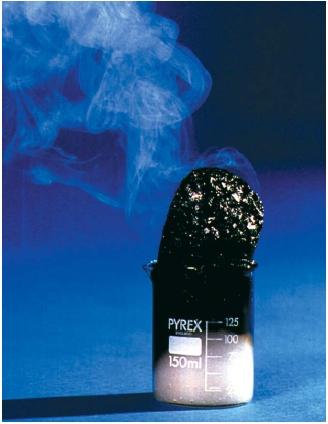
the sugar in a highly exothermic reaction, releasing heat, steam, and
sulfur oxide fumes. Aside from the sulfurous odor, the reaction smells a
lot like caramel. The white sugar turns into a black carbonized tube
that pushes itself out of the beaker. Here's a nice youtube video for you, if you'd like to see what to expect.
What Happens
Sugar
is a carbohydrate, so when you remove the water from the molecule,
you're basically left with elemental carbon. The dehydration reaction is
a type of elimination reaction.
C12H22O11 (sugar) + H2SO4 (sulfuric acid) → 12 C (carbon) + 11 H2O (water) + mixture water and acid
Although
the sugar is dehydrated, the water isn't 'lost' in the reaction. Some
of it remains as a liquid in the acid. Since the reaction is exothermic,
much of the water is boiled off as steam.
Safety Precautions
If
you do this demonstration, use proper safety precautions. Whenever you
deal with concentrated sulfuric acid, you should wear gloves, eye
protection, and a lab coat. Consider the beaker a loss, since scraping
burnt sugar and carbon off of it isn't an easy task. It's preferable to
perform the demonstration inside of a fume hood.
Tuesday January 29, 2008
منبع :http://minashimi.mihanblog.com
با تشکر از سرکار خانم مهندس ترکاشوند
